

Beige
#F5F5DCThe standard CSS beige: a very light, pale yellow-cream neutral used as a soft background.
A beautifully considered library of 92 distinct beige colors — from delicate ivory to warm sand and sophisticated greige. Find your shade, explore its details, and make it yours.
Curated by Ahmed Aden Image to Color Independently described sRGB shades
Beige is a family of pale, low-to-moderate saturation neutrals that generally blend soft yellow, cream, tan, and warm gray undertones. The standardized CSS color beige is #F5F5DC — but there is no single universal HEX code for every shade called “light beige” or “warm beige.”
Explore each shade as a distinct sRGB value. Where a name is not a standardized CSS keyword, we mark it as a descriptive name rather than implying an official paint specification.
All 92 curated swatches in one downloadable chart, with names and HEX codes.
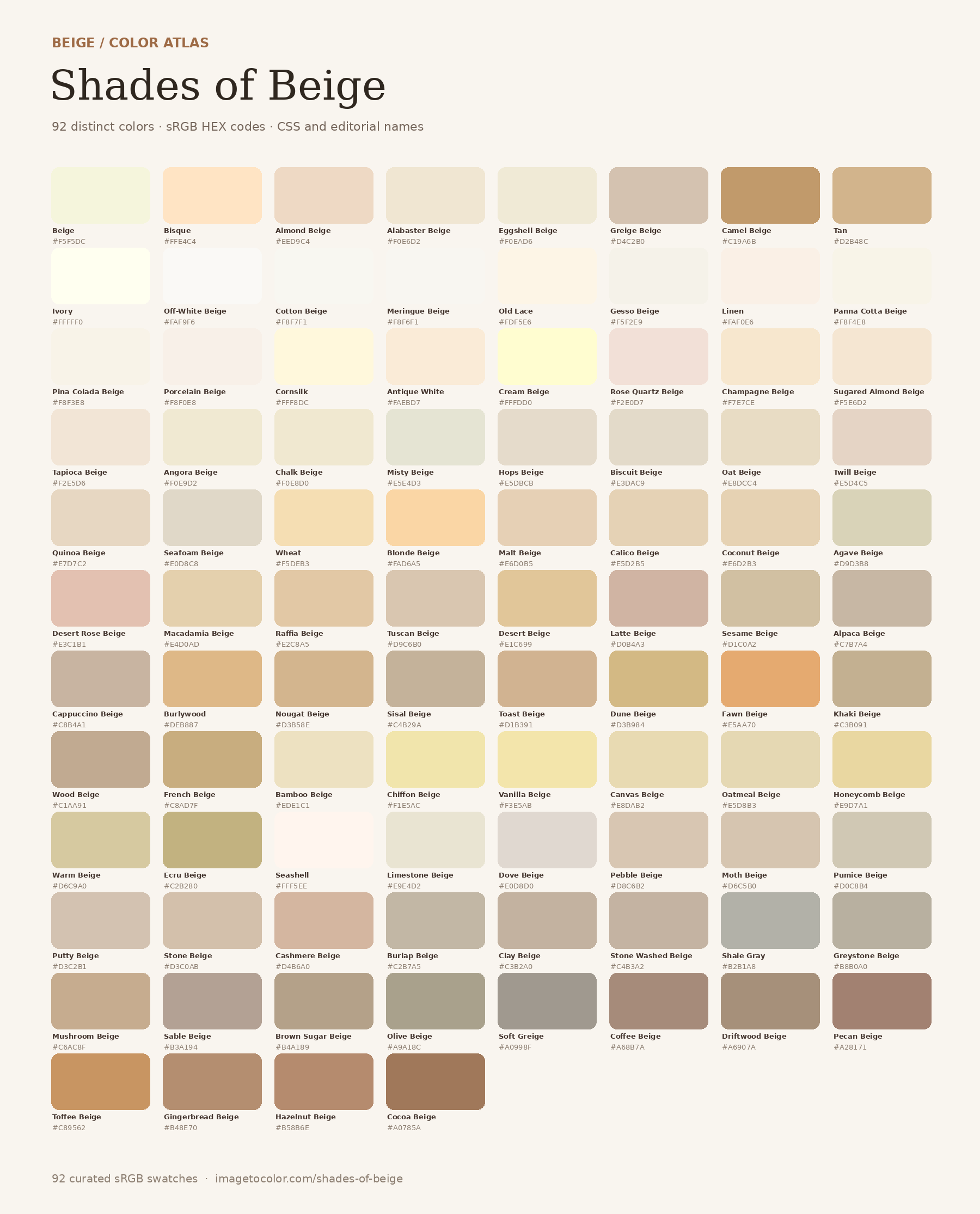
Preview of the full 92-shade chart; click to view the complete image. Original chart created for this library. Color appearance varies by display and ambient lighting; HEX values are the reproducible reference.
Search by name or HEX, explore palettes by mood, and copy any color in a click.
92 shades to explore
Click a swatch to copy · Explore shade for details
#F5F5DCThe standard CSS beige: a very light, pale yellow-cream neutral used as a soft background.

#FFE4C4The standard CSS bisque: a pale peach-cream neutral with a softly warm bias.

#EED9C4A soft beige with a light nutty undertone, resembling almonds.

#F0E6D2A very light creamy beige with the subtle warmth of pale alabaster.

#F0EAD6A soft eggshell-inspired pale beige, more creamy than pure white.

#D4C2B0A muted beige-gray blend: warmer than most cool grays, softer than traditional tan.

#C19A6BA warm camel-tan beige with a deeper earthy shade than the classic CSS beige.

#D2B48CThe standard CSS tan: a mid-tone sandy beige-brown with moderate warmth.

#FFFFF0The standard CSS ivory: a very light off-white with a restrained warm tint.

#FAF9F6A beige that's very close to white with a slight hint of warmth.

#F8F7F1An almost-white, slightly warm neutral like natural unbleached cotton.

#F8F6F1A very light, slightly off-white beige, like meringue.

#FDF5E6The standard CSS old lace: a pale parchment-cream off-white.

#F5F2E9A very light beige, resembling the color of gesso used in painting.

#FAF0E6The standard CSS linen: a pale warm off-white with a faint peach-cream tint.

#F8F4E8A very light, creamy beige, like Panna Cotta dessert.

#F8F3E8A very light beige, creamy with a slight yellow undertone, like a Pina Colada drink.

#F8F0E8A very light, smooth beige, like porcelain.

#FFF8DCThe standard CSS cornsilk: a very light, creamy yellow-white neutral.

#FAEBD7The standard CSS antique white: a subtle cream off-white inspired by aged paper.

#FFFDD0A soft, light beige with a creamy, warm undertone.

#F2E0D7A light beige with a subtle pink undertone, like rose quartz.

#F7E7CEA light champagne-toned beige with a gentle golden-cream undertone.

#F5E6D2A light, slightly sweet beige, like sugared almonds.

#F2E5D6A light, creamy beige, like tapioca pudding.

#F0E9D2A very light neutral beige with a soft warm cast, inspired by the color of angora.

#F0E8D0A light, muted beige, resembling the color of chalk.

#E5E4D3A gentle gray-cream beige with light yellow undertones; muted rather than metallic.

#E5DBCBA muted, warm beige with a slight yellowish undertone, like dried hops.

#E3DAC9A warm, muted biscuit-colored beige between cream and pale stone.

#E8DCC4A pale oat-beige with subdued golden undertones and a gentle, powdery appearance.

#E5D4C5A light peach-sand neutral, reminiscent of naturally undyed twill fabric.

#E7D7C2A light beige with a slight white and yellow undertone, like quinoa seeds.

#E0D8C8A pale neutral with muted green-cream notes; the swatch itself is a flat color, not a seafoam texture.

#F5DEB3The standard CSS wheat: a light golden-beige with gently warm undertones.

#FAD6A5A light golden sand with warm yellow-peach undertones.

#E6D0B5A softly warm beige with cream-and-grain undertones.

#E5D2B5A light beige with a varied undertone, like calico fabric.

#E6D2B3A pale sand-and-coconut beige with moderate warmth and a soft golden hue.

#D9D3B8A light, earthy beige with a subtle green undertone, like agave fibers.

#E3C1B1A warm beige with a slight pinkish undertone, inspired by the desert rose.

#E4D0ADA creamy beige with a slightly nutty undertone, like macadamia nuts.

#E2C8A5A warm, mid-light sand beige resembling the straw-gold hue of dried raffia.

#D9C6B0A warm, medium beige inspired by the Tuscan countryside.

#E1C699A medium-toned beige, like the color of desert sand.

#D0B4A3A light brown beige, like the color of a latte drink.

#D1C0A2A light beige with a slight speckling, like sesame seeds.

#C7B7A4An understated mid-light beige-brown reminiscent of natural alpaca wool.

#C8B4A1A warm, light brown beige, reminiscent of a cappuccino drink.

#DEB887The standard CSS burlywood: a medium warm sand-and-wood brown.

#D3B58EA medium brown-beige, with a sweet undertone, like nougat candy.

#C4B29AA neutral and warm beige, like sisal fibers.

#D1B391A medium beige with a toasted appearance.

#D3B984A sandy beige with a slight grey undertone, like sand dunes.

#E5AA70A mid-tone golden peach-brown, sitting at the warm edge of the beige family.

#C3B091A medium beige with a greenish, earth undertone, like khaki fabric.

#C1AA91A beige with a brown tint, reminiscent of wood.

#C8AD7FA slightly greyish beige, often associated with French style.

#EDE1C1A light beige with a slight yellowish-green undertone, like bamboo.

#F1E5ACA very light and sheer beige with a delicate look.

#F3E5ABA light, creamy beige with a warm and inviting undertone, like vanilla.

#E8DAB2A medium, neutral beige, reminiscent of canvas fabric.

#E5D8B3A light neutral beige with a sandy-golden cast, inspired by the color of oatmeal.

#E9D7A1A light golden beige with honeycomb-like warmth and soft yellow undertones.

#D6C9A0A beige with a pronounced warm, golden undertone.

#C2B280A pale, greyish-yellow beige, like unbleached fabric.

#FFF5EEThe standard CSS seashell: an almost-white shade with a delicate pink-peach cast.

#E9E4D2A light, slightly rough beige, like limestone.

#E0D8D0A light, soft beige with grey undertones, like a dove's feathers.

#D8C6B2A light neutral beige with a gray-warm cast, inspired by the color of pebble.

#D6C5B0A medium beige, resembling the color of a moth, with an earthy undertone.

#D0C8B4A light neutral beige with a gray-warm cast, inspired by the color of pumice.

#D3C2B1A middle-light stone beige with a muted gray-brown undertone.

#D3C0ABA medium beige with a cool grey undertone, like stone.

#D4B6A0A delicate peach-tan beige with softly warm undertones.

#C2B7A5A medium neutral beige with a gray-warm cast, inspired by the color of burlap.

#C3B2A0A medium, earthy beige, like dried clay.

#C4B3A2A slightly faded, greyish beige, like stone-washed fabric.

#B2B1A8A medium to dark beige with a grey undertone, like shale stone.

#B8B0A0A medium beige with a stony gray undertone.

#C6AC8FA beige with greyish undertones reminiscent of mushrooms.

#B3A194A gently muted gray-brown beige, deeper than sand but lighter than cocoa.

#B4A189A medium warm taupe-beige with gentle brown undertones.

#A9A18CA beige with a greenish undertone, like olive oil.

#A0998FA medium muted greige balancing warm taupe-brown with a low-saturation gray cast.

#A68B7AA medium brown-beige, like the color of coffee.

#A6907AA medium to dark beige with a gray and brown undertone, like driftwood.

#A28171A medium brown-beige, like the color of pecan nuts.

#C89562A medium brown beige with a rich, sweet undertone, like toffee.

#B48E70A medium-dark beige with warm, spicy undertones, like gingerbread.

#B58B6EA medium beige with a brown and reddish undertone, like hazelnut.

#A0785AA medium-dark brown beige, like cocoa powder.
Try another color name, HEX value or filter.
This library contains 92 unique swatch codes, edited from 150 submitted records. Names not listed as CSS keywords are practical descriptions, not official manufacturer specifications. All swatches are present in the page HTML, even with JavaScript disabled.
Example lighter and darker variations around CSS Beige #F5F5DC, prepared as an illustrative tonal progression.
Three palettes for different design moods. Click a color to copy its HEX code.
Soft paper neutrals grounded by rich espresso. Works well for magazine-style interfaces, stationery, and calm product stories.
Linen and sunlit sand with a muted sage contrast. An understated direction for interior moodboards and wellness identities.
Cool stone neutrals and near-black type make a restrained, modern interface with comfortable hierarchy.
Reliable color details beat vague promises. Here's what the numbers and names actually mean.
The CSS named color beige is #F5F5DC, or RGB (245, 245, 220). Other beige shades don't share one universal HEX code.
Beige typically refers to a light warm neutral; tan is generally deeper and browner; greige blends beige-like warmth with gray. These are descriptive families, not fixed technical classifications. The CSS named color tan is #D2B48C.
No. Some entries match official CSS named colors and are identified in their details. The remaining names are descriptive labels supplied for browsing and comparison. For precise reuse, copy the HEX, RGB, or HSL value.
Check contrast, not just whether a color looks dark or light. Each swatch detail shows measured ratios against black and white. WCAG AA typically needs a contrast ratio of at least 4.5:1 for normal-size text; large text has a 3:1 threshold.
Yes. HEX values represent sRGB colors and can be pasted into common design tools and CSS. Colors may look different across screens or printed material, so check appearance in the actual output environment.
We reviewed an initial collection of 150 labels, removed codes that were repeated or clearly outside the beige family, and kept 92 distinct sRGB swatches. HEX, RGB and HSL are transparent conversions of the same color; CSS standard names are labeled separately from descriptive names. Groupings and usage notes remain editorial design guidance rather than scientific or manufacturer claims.
CSS named-color reference ↗WCAG contrast guidance ↗